MapForge: seeded dungeon and cave maps, straight into Godot 4
Every roguelike starts with the same unpaid work: a BSP splitter, a cellular-automata pass, a connectivity check so no room is stranded, then hand-wiring a TileSet and drawing collision on every wall tile.
MapForge hands you that part, already wired for Godot.
Pick an algorithm, keep the seed:
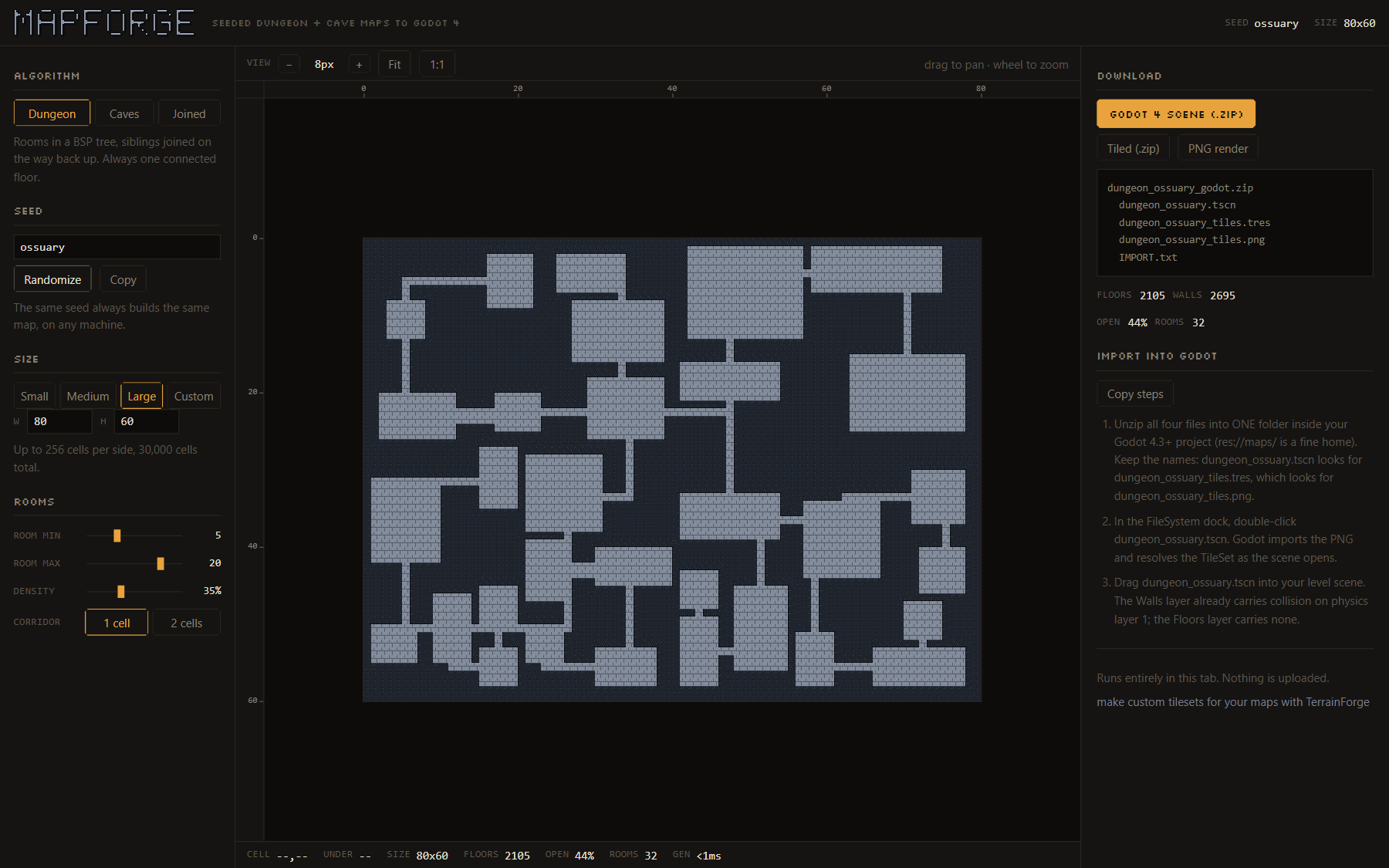
- Dungeon. Rooms in a BSP tree, siblings joined on the way back up. Always one connected floor, never an orphan room.
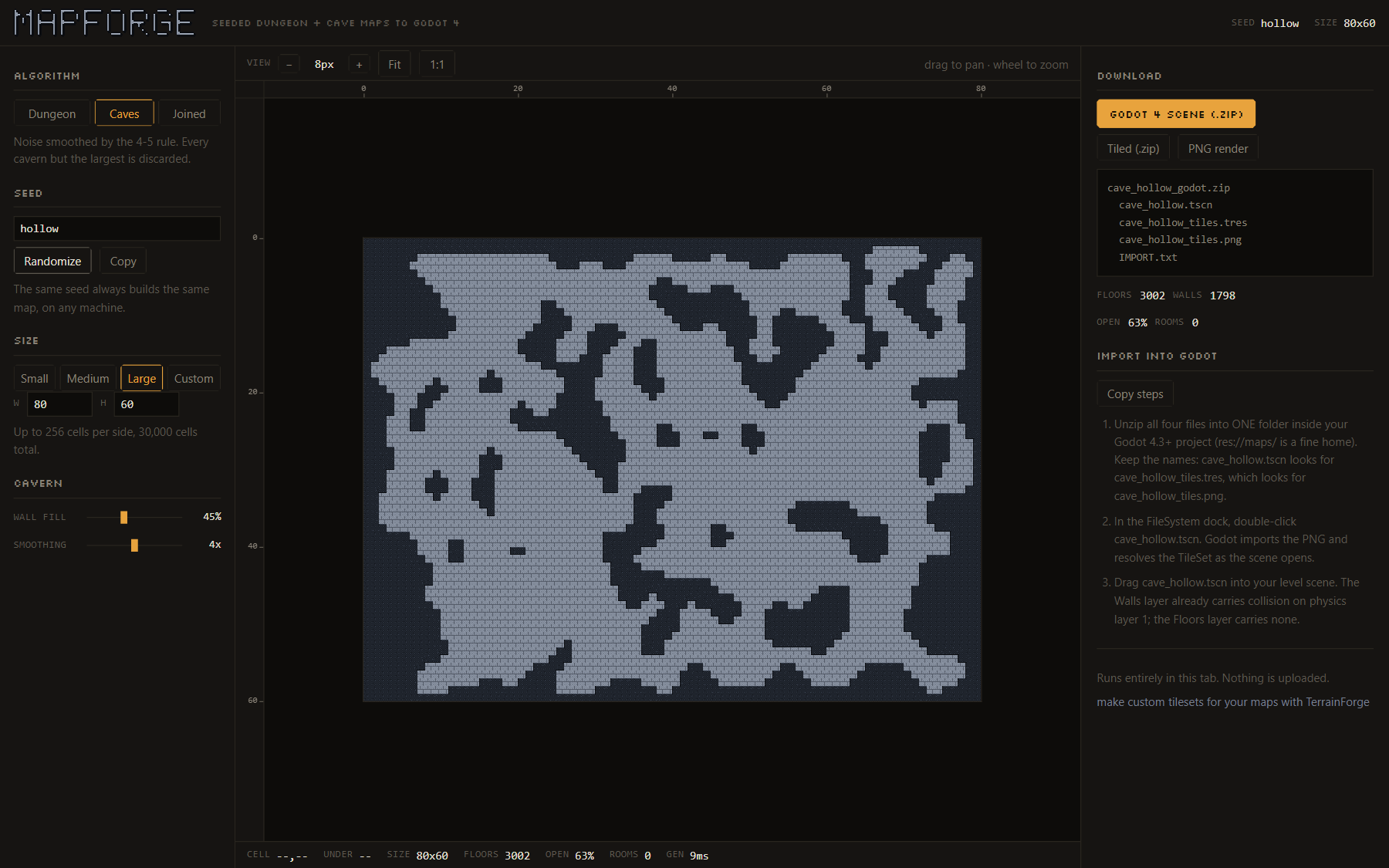
- Caves. Noise smoothed by the 4-5 rule, every cavern but the largest discarded, so no unreachable pockets.
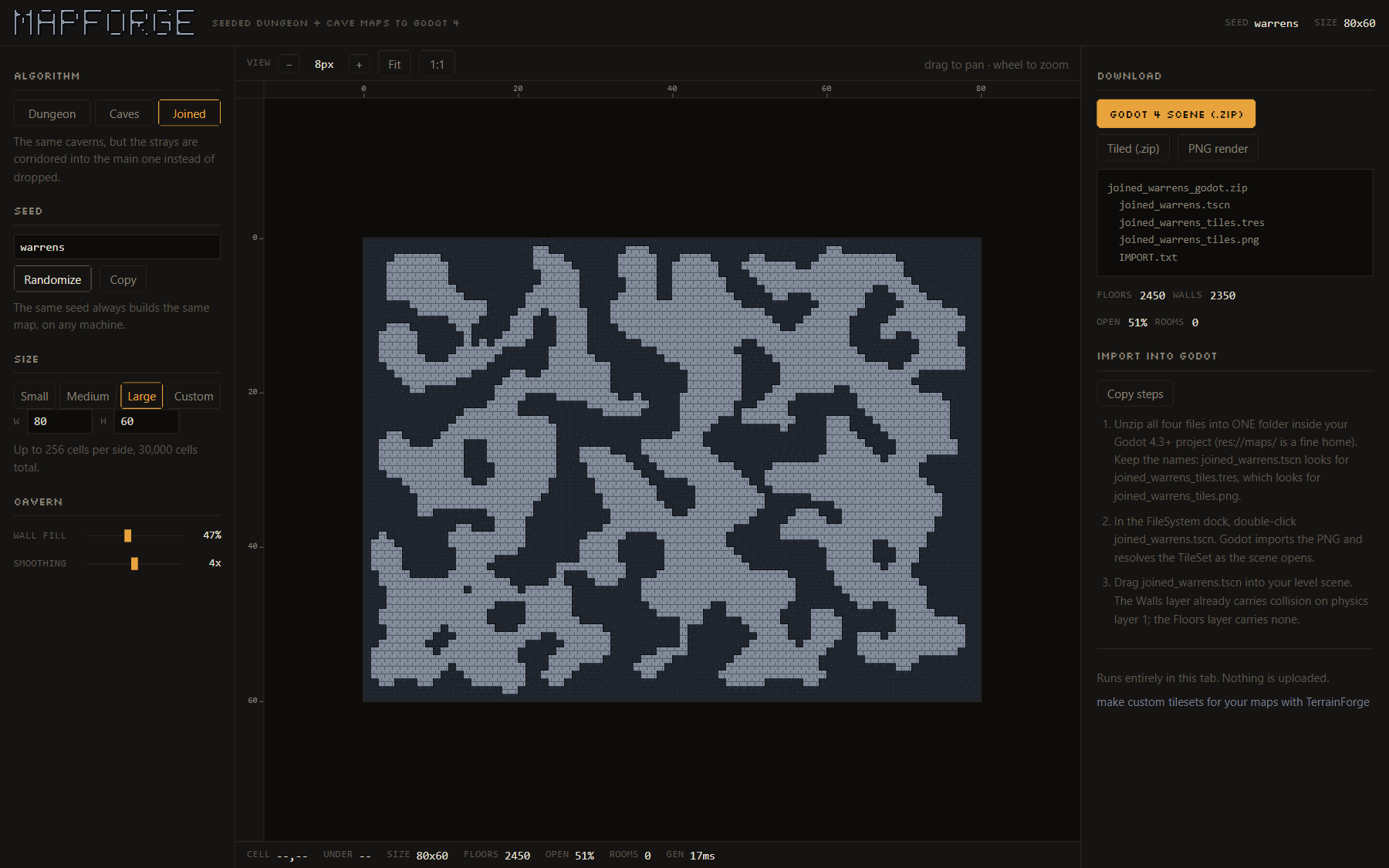
- Joined. Caves, then corridors cut between the surviving regions.
- Tune room size, density, corridor width, wall fill and smoothing passes. The map regenerates as you drag.
- Seeds are deterministic. The same seed rebuilds the same map on any machine running the same build. Paste it into a bug report or a level list and it reproduces exactly.
Download what you actually needed:
- Godot 4 scene (.zip). A .tscn with two TileMapLayers, the .tres TileSet, the tileset PNG, and a three-step import note. The Walls layer already carries collision on physics layer 1. The Floors layer carries none. Drag it into your level and walk around.
- Tiled (.zip). .tmx + .tsx + PNG, with a full-tile collision polygon on every wall tile and a wangset for terrain painting.
- PNG render. For design docs and devlogs.
Free generators like watabou's One Page Dungeon are excellent and you should use them. They hand you a picture. This hands you a scene your player can collide with.
This build was validated by opening its own exports in the real programs, not just unit-tested. Godot 4.7.1: cell counts checked against the generator, every used cell resolved to a real atlas tile, walls confirmed collidable, floors confirmed not. Tiled 1.12.2: all four gate maps parse, both layers survive at full cell count, the external tileset resolves, and 47 of 47 wall tiles carry their collision polygon. Both gates include a deliberate wrong-expectation case, so a pass has to mean something. 195 unit tests behind that.
Honest limits (v1):
- Godot 4.3 or newer. Scenes use TileMapLayer, which does not exist in 4.2 or earlier. There is no Godot 3 export.
- Maps cap at 256 cells per side and 30,000 cells total. Above that, generation stops being interactive.
- Ships its own procedurally generated stone tileset: 16px tiles on a 128x96 sheet, 47 wall tiles plus one floor tile. There is no art import in the tool. Using your own art means swapping the exported PNG by hand for a sheet in the same 8x6 layout at the same tile size, renamed to match that export.
- One terrain set of two terrains. No multi-terrain transitions, no alternative tiles.
- Collision is one full-tile box per wall. Fine for grid movement, not for sloped or partial-tile shapes.
Everything runs in your browser tab. Nothing is uploaded. The paid version is a single HTML file you download and run offline: no network calls, no account.
Demo vs full: The free browser demo above is the whole tool, capped at 40x30 maps. The paid download is uncapped, with v1.x updates included.
Pay what you want, $5 minimum. If it saves you an evening of writing and debugging a splitter, $7 is the fair price.
Made by deforestpeg, with AI writing most of the code (hence the Code tag). The generators are plain deterministic software: no AI at runtime, no generated art beyond the bundled tileset we drew ourselves, and nothing leaves your browser.
Purchase
In order to download this tool you must purchase it at or above the minimum price of $5 USD. You will get access to the following files:
Development log
Leave a comment
Log in with itch.io to leave a comment.